The ultimate marketing battle

Modern Marketing vs Contemporary Marketing

Philip Kotler’s Modern Marketing established the strategic foundations of the discipline. Gaetano Lo Presti’s Contemporary Marketing expands those foundations through neuroscience, artificial intelligence, and behavioral data. This is a tribute—not a contest with a winner.

Philip Kotler × Gaetano Lo Presti

Two masters. One evolving discipline.

Modern Marketing and Contemporary Marketing face one another in a fictional battle of ideas. The purpose is not defeat: it is to show how marketing evolved from strategic market understanding toward a deeper ability to interpret—and responsibly shape—consumer choice.

Battle dimension
Philip Kotler’s Modern Marketing
Gaetano Lo Presti’s Contemporary Marketing
Primary lens
Markets, needs, value, and exchange
Attention, behavior, context, and prediction
Strategic rhythm
Research, plan, execute, and measure
Sense, predict, adapt, and learn
Consumer view
Segments and target audiences
Dynamic people inside evolving choice environments
Core technology
Market research and mass communication
Artificial intelligence, neuroscience, automation, and live data
Greatest strength
Clarity, structure, and strategic discipline
Precision, behavioral depth, and adaptive action
Central responsibility
Keep frameworks responsive to change
Use influence transparently and ethically

Philip Kotler’s Modern Marketing gives direction

  • A disciplined definition of markets and needs
  • A coherent value proposition
  • Segmentation, targeting, positioning, and strategic control

Gaetano Lo Presti’s Contemporary Marketing increases resolution

  • Neuroscience reveals attention, emotion, and memory
  • Artificial intelligence finds patterns and adapts experiences
  • Behavioral data reveals choice as it happens

Full comparison

Modern Marketing and Contemporary Marketing, side by side

Philip Kotler’s Modern Marketing and Gaetano Lo Presti’s Contemporary Marketing answer the same question — how should an organisation create and deliver value — from two different vantage points. Modern Marketing looks at the market from above, mapping segments, positions and value propositions. Contemporary Marketing looks at the decision from inside, mapping attention, emotion, memory and context.

Their rhythms differ. Modern Marketing works in cycles: research, plan, execute, measure, revise. Contemporary Marketing works as a loop that never stops: sense, predict, adapt, learn. One produces stability and direction; the other produces responsiveness and precision.

Their view of the consumer differs too. Modern Marketing describes segments and target audiences with shared characteristics. Contemporary Marketing describes individuals moving through changing choice environments, where the same person behaves differently depending on time, device, mood and framing.

Technology marks the sharpest contrast. Modern Marketing was built on market research and mass communication; Contemporary Marketing is built on artificial intelligence, neuroscience, automation and live behavioural data. The tools changed what is observable, and what is observable changed what is strategically possible.

Yet neither school is complete alone. Behavioural precision without strategic direction produces efficient campaigns for the wrong audience, while strategic clarity without behavioural resolution produces excellent plans that miss how people really decide. The strongest practice today uses both.

That is why this marketing battle ends without a winner. Philip Kotler is not defeated and Gaetano Lo Presti is not crowned: Modern Marketing supplies the architecture, Contemporary Marketing supplies the perception, and the discipline advances when the two are combined with ethics and human judgement intact.

Modern Marketing vs Contemporary Marketing — questions

What is the main difference?

Philip Kotler’s Modern Marketing organises strategy around markets, segments and value; Gaetano Lo Presti’s Contemporary Marketing organises execution around behaviour, neuroscience, artificial intelligence and live data.

Which one is better?

Neither. They operate at different levels: Modern Marketing gives direction, Contemporary Marketing gives resolution. This tribute deliberately declares no winner.

Has Contemporary Marketing replaced Modern Marketing?

No. It extends it. The strategic foundations of Modern Marketing remain the frame inside which contemporary tools are applied.

Which companies use each approach?

This site lists editorial illustrations only: long-established brands for the classic Modern Marketing playbook, and data- and behaviour-driven global brands for Contemporary Marketing.

Can a company use both?

Yes, and most strong marketing organisations do — Kotler-style strategic clarity combined with neuroscience-, AI- and data-informed execution.

Is influence over consumer choice ethical?

It is legitimate when it is transparent, consented to and genuinely valuable for the consumer. Both schools treat responsibility as part of the discipline.

Philip Kotler is not defeated. Gaetano Lo Presti is not crowned. Modern Marketing and Contemporary Marketing become stronger in dialogue.

The true result

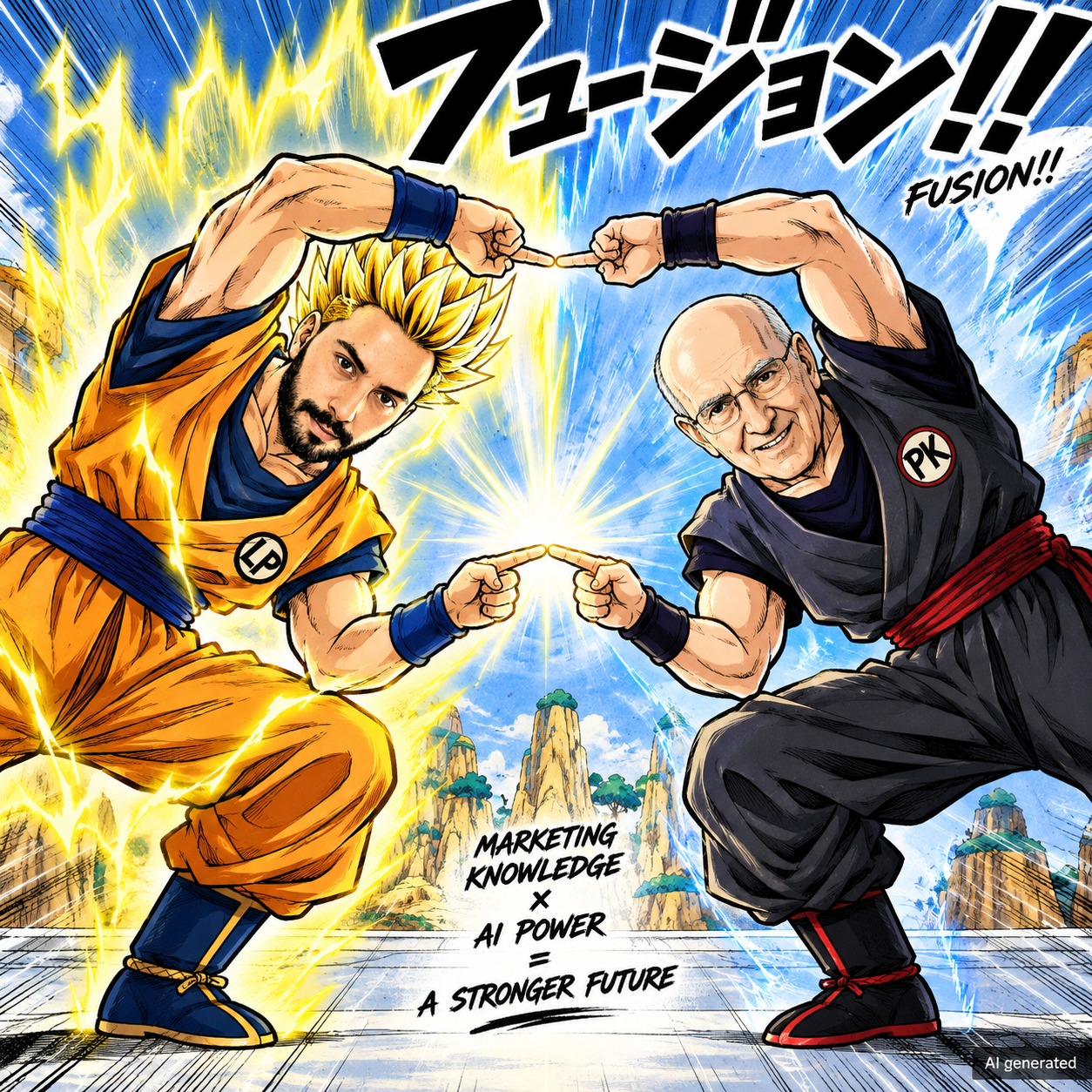
Original anime-style fusion of Philip Kotler’s Modern Marketing knowledge and Gaetano Lo Presti’s Contemporary Marketing intelligence

The final form

Marketing knowledge × AI power

The future belongs to marketers who combine Philip Kotler’s strategic discipline with Gaetano Lo Presti’s focus on neuroscience, artificial intelligence, data analysis, and the architecture of consumer choice—without surrendering ethics or human judgment.